Summer is blinkin hot in Kyoto, so this time of year we need meals that not only nourish but also cool. Cold noodles; soba, udon and somen are a staple. In addition to ice and cold, the Japanese like summer dishes to be quite salty and sometimes to include some kind of bitter taste. I developed this beautiful and tasty cold noodle dish recently and thought you might like to take a look. It uses bitter radish and homemade pickled ginger for flavor and I garnished it with a parboiled ‘hot spring’ egg. Even if you can’t get all the same ingredients, I hope that it inspires you!
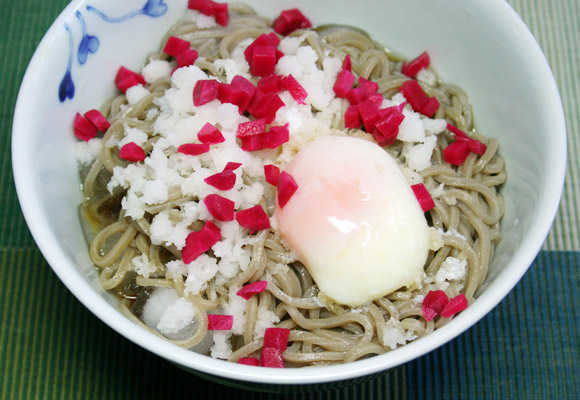
Cold Summer Noodles: Iced Soba with Karami Daikon, Beni Shoga and Onsen Tamago
After I did this article on my favorite cold udon at Tsunamichi I thought that I ought to do a recipe post too. I somehow came up with this simple recipe that is really quite great. Unfortunately the ingredients are not readily available overseas, I think. However, if you are a real foodie, you could easily grow the radishes and make the pickled beni shoga ginger yourself.
The Ingredients
nama (fresh) soba or udon
karami bitter daikon radish
beni shoga pickled ginger
tsuyu (dashi-broth based sauce)

Cold Summer Noodle Ingredients: Nama (Fresh) Soba, Karami Daikon (Radish), Beni Shoga (Ginger)
I made umeboshi this year, for the first time, so I have two big plastic buckets in my kitchen full of pickling plums. One variety includes fresh ginger and the ume and ginger are naturally colored a deep and beautiful (and tasty) red with heaps of red perilla shiso leaves. (ume articles on the way)
I just reached into the umeboshi barrel and pulled out some beni shoga for this dish. If you like beni shoga, you have to make this at home. It is really not very difficult. Just buy a bunch of ‘shin shoga’ new ginger when it is in season. You would probably just have to grow your own red shiso as you need quite a bit. This is a wonderful condiment and will keep forever.
By the way, if you cannot get ‘nama’ noodles, dried will work too. A regular daikon radish could be substituted and the top, near the greens, is usually the most bitter part of the radish. A hot western radish would likely work too.

Cold Summer Noodles: Beni Shoga from the Umeboshi Barrel

Cold Summer Noodles: Umeboshi Vintage 2010 (in process)
I don’t make my own tsuyu. It usually includes dashi, shoyu and mirin. A lot of bottled tsuyu (and dashi) is full of chemicals like MSG. If you pay a little more you can get excellent tasting natural tsuyu, that is what I use. It usually is in concentrated form. I guess if I were a real foodie I would make my own. I will have to try that one day!
Nama (fresh, lit. raw) noodles take just 3 minutes or so to boil. Once I start the noodles I pour some tsuyu over ice in the serving bowl. If you are having guests, put the bowls in the freezer well before serving so that they are still frosty cold to the touch when they are served. That would be very ‘Kyoto’.
After the noodles have cook, rinse them with cold water several times until they are cold. The colder the better, use ice water to chill them if possible.

Cold Summer Noodles: Ice and Tsuyu
Grate the karami daikon and slice the beni shoga while the noodles are cooking and chilling. I grate about 2 to 3 tablespoons of daikon per serving. That is maybe a bit much as it is quite potent stuff. I can sometimes feel it burning in my tummy after the meal. The beni shoga is very salty so I use about a teaspoon or so. If it is too salty for you simply soak in water for 10 minutes or so and squeeze before dicing. You could also soak and squeeze after dicing but that will remove some flavor too. The smaller you can dice the ginger the more ‘Kyoto’ it will be.
Place the noodles over the ice and tsuyu and turn over a few times with your fingers or chopsticks. Then add the grated daikon and pickled ginger. An onsen tamago (hot spring egg) is also a nice addition. (No Recipes has a good recipe for onsen tamago here.)

Cold Summer Noodles with Tempura Served: Iced Soba with Karami Daikon, Beni Shoga and Onsen Tamago
I need some calories to keep me going in the hot summer so I like to have cold noodles with tempura. I usually buy tempura in the supermarket. I get kakiage ‘mixed’ tempura and often add it to my bowl of noodles after I have had a few bites. (Here are a few Kyoto kakiage links: Gion Tenshu, Yoshikawa Tempura and Marugame Udon)

Cold Summer Noodles with Tempura – All Mixed Up
SHARE! Kyoto Support Topic: Food and Drink in Kyoto
Tweet! Tweet! Find out what’s going on in Kyoto right now, follow me on Twitter.
More on KyotoFoodie about Karami Daikon here.
Kitazawa Seed Company sells karami daikon seeds online, you could grow them yourself!
(c) Kyoto Foodie: Where and what to eat in Kyoto – Read entire story here.