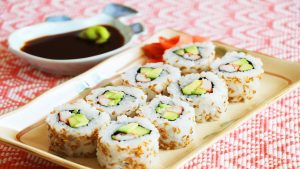
I love them so much that if I could only eat one type of sushi for the rest of my life, it would be a California roll. Well, kind of.

What I actually love are the California rolls that I make (and only the California rolls that I make). In fact, before I became a sushi chef, I didn’t even like California rolls. I now understand the reason was not because California rolls are inherently bad but because most California rolls are made badly.
 SIDE NOTE: One of my biggest workplace pet peeves is hearing people (and these people are never sushi chefs) pompously announce that they don’t eat California Rolls because they aren’t “real sushi.” At moments like those oh how I would love to pull out a canned air horn, push the button for about five seconds and then scream at the top of my lungs: “Wronnnnnnnnnnnnng!” So for all of you self-proclaimed “sushi snobs,” get over yourselves. California Rolls are definitely “real sushi“.
So what exactly is it that I do that makes my California rolls so good? Answer: I make them with love.
California rolls really seem to fall victim to this type of apathy because of the aforementioned belief that they are not real sushi. It’s as if California rolls are treated as “freebies” and simply thrown into a standard combination plate, therefore not worthy of proper attention and care. Rarely are the cucumbers fresh and crunchy. The avocados tend to be too mushy and the rice is cold. When I make them, I do the opposite of all of this (and so will you when you make your own). Let me break this down for you, step-by-step.
#1) Use perfectly ripened avocados
Do not use an avocado that can be used for guacamole. In other words, it should not be too soft or mushy. It, too, should not be hard. Think about what a just ripened yellow banana (no brown spots or green stripes) feels like if you lightly squeeze it. This type of banana will be firm but it will also give just a teeny, tiny bit when you press it with your thumb and fingers. The same should be true of the avocado you use to make a California roll.
#2) Only use freshly cut cucumbers (that means freshly cut within minutes)
You can’t imagine how big of a difference this will make in almost every type of sushi roll you make. Don’t make the same mistake that most restaurants that serve sushi make, and cut your cucumbers hours ahead of time. A cucumber that was cut into shoestrings, wrapped in plastic and stored in a refrigerated case seven hours before you arrived to the sushi bar is not going to be “bad.” But… it sure isn’t going to taste as fresh as one that was cut minutes before you bit into it.
To be fair, these restaurants don’t really have a choice; because they serve so many customers, they can’t take the time to cut a cucumber every time a customer orders something. However, to be fair to the true essence of sushi, sushi restaurants were never intended to be so large that you needed to cut cucumbers hours ahead of time.
#3) Warm rice, warm rice, warm rice
By now you should know how I feel about the importance of using warm sushi rice when making sushi. If not, you can find out about it here.
#4) Imitation crab vs. real crab.
 I bet you don’t know where I am going with this one. Well, if I can only choose one, then I choose imitation because when making California rolls, imitation crab is a much better choice than fresh crab. Surprised? It actually makes sense. If I had fresh crab legs, why would I roll them up in rice, seaweed and then dip them in soy sauce, possibly hiding most of the flavor of the crab? What I would rather do for those crab legs is melt some butter, cut a few lemon wedges and pour myself a martini (and, of course, use the imitation crab for my California rolls).
Now just in case you were under the misbelief that imitation crab isn’t eaten in Japan, let me assure you that it is. Imitation crab is as popular in Japan as peanut butter is in the United States. You can find it most kitchens, in every supermarket and in many dishes served in restaurants throughout Japan. Where do you think this stuff came from? And that reminds me, all imitation crab is not made equally. When making California rolls, I highly recommend that you use imitation crab from Japan.
(c) SUSHI GIRL ® – Read entire story here.