Price:
(as of Jan 04,2023 04:30:00 UTC – Details)

EVERYTHING YOU NEED TO KNOW ABOUT JAPANESE CUISINE
Sushi has a long and illustrious history, and one of the most remarkable aspects of this history is that sushi is always developing. Sushi, which was first described in China during the second century, was initially developed as a method of food preservation. Fish was put in rice and left to ferment, which allowed the fish to remain edible for an extended period of time. The rice was subsequently thrown away, and the fish was consumed as and when it was necessary.\
Throughout China, the practice gained popularity, and by the seventh century, it had found its way to Japan, where seafood has long been a staple dish. The Japanese made a modest modification to the method by electing to consume the rice along with the fish instead of separately. Rice had been seasoned by the 17th century, transforming what had originally been a salvific procedure into a well enjoyed delicacy. Matsumoto Yoshi chi of Edo (now Tokyo) pioneered the production of instant sushi,’ which is considered the origin of modern-day sushi.
MODERN SUSHI
A guy by the name of Hanaya Yohei envisioned a major shift in the way sushi was made and given to the public in the early nineteenth century. Instead of wrapping the fish in rice, he placed a piece of fish on top of an oblong-shaped piece of seasoned rice, which he then wrapped around the fish. As a result of this form of sushi, it is now known as either ‘nigiri sushi,’ or simply ‘edomae sushi,’ and it is one of the most popular ways to consume sushi not just in Japan, but also across the rest of the globe.
Anaya Yoshie and other sushi chefs marketed this innovative new type of sushi from street booths all around the city and surrounding areas. Despite the fact that the booths were extremely popular with the bustling Japanese culture prior to World War II, the stalls were forced to close and relocate indoors, where it was deemed more sanitary, after the war.
IT IS A WORLDWIDE phenomenon.
During the late 1970s, Japanese firms began expanding into the United States, and an increasing number of sushi restaurants sprang up to cater to the Japanese businessmen who were based in the area. It was often regarded as a “Japanese twist on fast food,” and while it was first intended as a short snack, it swiftly evolved into a full-fledged dining experience for those unfamiliar with the concept.
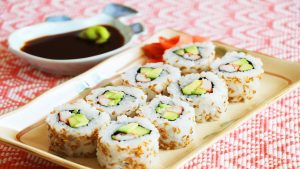
Without a question, Sushi had piqued the curiosity of many Americans, but many were hesitant to eat raw fish because of the dangers associated with it. The California Roll was established as a method to gradually introduce folks who were unfamiliar with sushi — it is the ideal starter piece of sushi. Sushi was a huge popularity, and as more and more Westerners began to consume sushi, Edo-style sushi began to mingle with western culture.
WHAT TO EXPECT IN THE NEW YEAR?
For the purposes of this article, sushi is defined as any food that is created using vinegared sushi rice. It is a popular misconception that the name sushi refers to “raw fish,” however this is not the case. Sushi is a Japanese word that literally translates as “it’s sour,” alluding to the sour flavor of vinegared rice. Aside from that, certain varieties of sushi do not include any fish at all, such as our Vegetarian Roll, which is stuffed with poached asparagus, cucumber, caramelised miso wild mushrooms, and burdock root, and then stacked with avocado and drizzled with sweet black miso aioli to finish.
In Australia and across the world, sushi may be found in a wide variety of flavors and textures.
ASIN : B09MYXZ71Y
Publisher : Independently published (December 8, 2021)
Language : English
Paperback : 186 pages
ISBN-13 : 979-8781392179
Item Weight : 9.9 ounces
Dimensions : 6 x 0.42 x 9 inches